

People who call our Sarasota office after a DUI arrest have usually already searched online. And most of them have read the same line somewhere: a first DUI “usually means probation and a fine.”
That’s partly true. It’s also why we like to slow down and walk through how Florida DUI penalties really work, because a handful of facts can change the picture before anyone sees a judge.

Key Takeaways
- Most penalties come from section 316.193, and they climb with each offense.
- A reading of 0.15 or higher brings tougher penalties.
- Your license runs on its own track, separate from the criminal case.
- We review the evidence before talking about any plea.
It’s built like a ladder
The penalties live mostly in one statute, section 316.193. Think of it as a ladder. Each fact about the arrest moves a case up or down a rung, and once the facts are set, the judge has limited room.
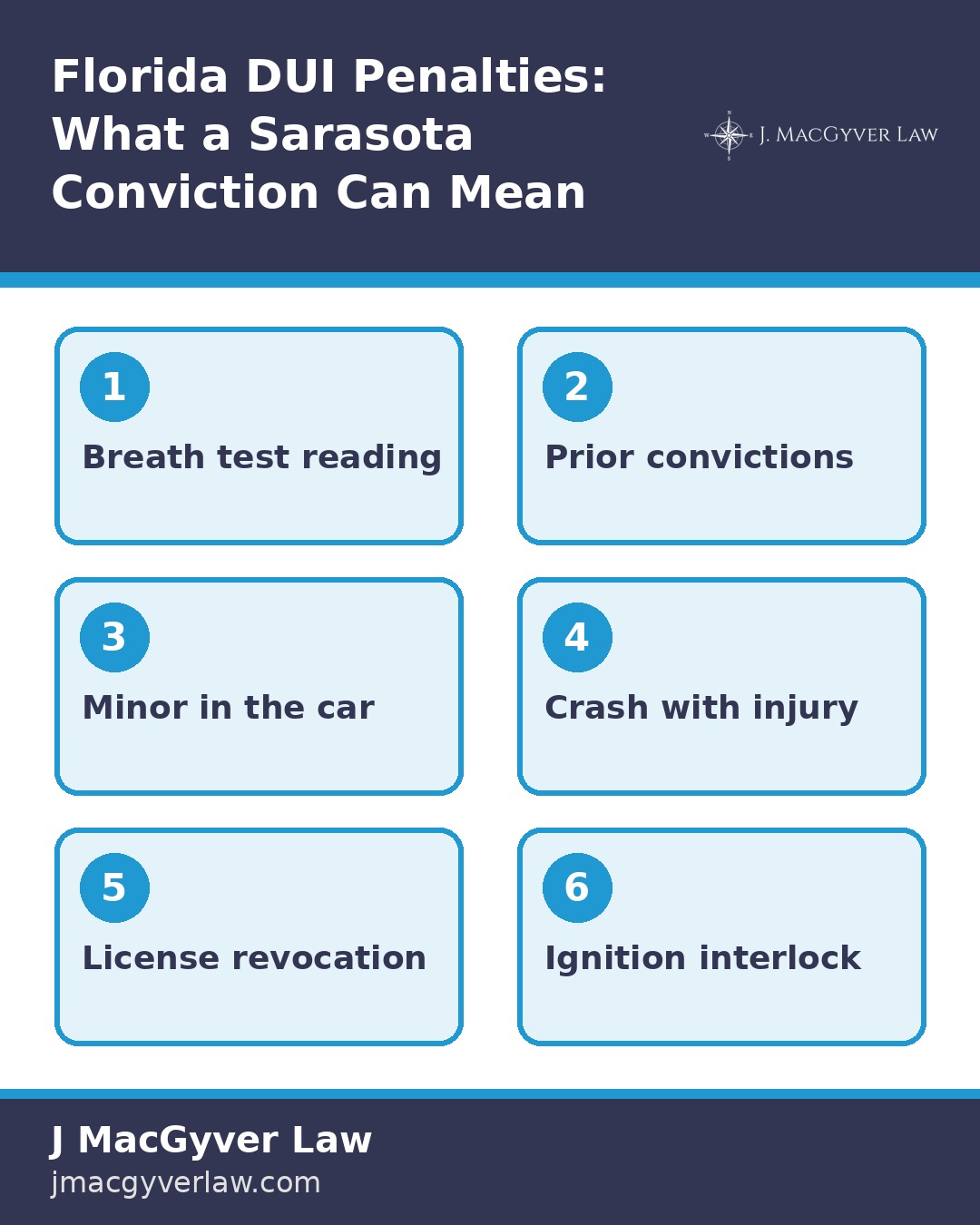
Three facts matter most:
How many prior DUI convictions someone has, and how long ago they were.
What the breath or blood alcohol reading was.
Whether anyone was hurt, or a child was in the car.
A plain first offense
For a first offense with a reading under 0.15, no crash and no minor in the vehicle, the penalties include probation, a fine set by statute, 50 hours of community service, DUI school, a 10-day vehicle impoundment and a license revocation of at least 180 days.
Jail is possible, up to six months, but it isn’t mandatory on a first offense.
When the reading is 0.15 or higher
This is where a lot of people get surprised.
If the breath or blood reading is 0.15 or higher, the state can file it as an enhanced first offense. That raises the maximum jail term to nine months. It also adds a required ignition interlock device for at least six months on a DUI conviction.
So someone’s real exposure can be a good deal higher than the “first DUI” they read about.
The license runs on its own track
Separate from the criminal case, the license is usually suspended on the spot at the arrest. For a breath reading of 0.08 or higher, that’s six months.
You have ten days to request a formal review hearing, or to waive it and apply for a business-purpose license so you can drive to work.
That decision comes long before any plea offer, so it comes first. And it’s not simple. A faster restricted license is great if you can’t get to work any other way. A hearing, though, puts the officer under oath, which can help the defense later. We weigh that against the whole case.

Before any plea, we look at the evidence
A plea offer from the State Attorney’s Office for the 12th Judicial Circuit often comes a few weeks after the arrest. That’s when people feel the most pressure.
Before deciding anything, we review the evidence. That means:
The dash camera and body camera video, to see the driving, the stop and the exercises.
The breath machine’s maintenance records and the operator’s certification.
The timing between the stop and the breath test.
The surface where the field sobriety exercises were done, like a sloped shoulder, and the person’s footwear.
Free Case EvaluationWhy those details matter
A stop has to be based on a lawful reason. If the video shows the driving issue was minor and brief, a motion to suppress could keep out everything that came after the stop.
If the breath machine was overdue for an inspection, that could undercut the reading itself.
Each issue changes how strong the state’s case is. And that changes how a plea offer looks.
Plea or fight?
A plea might reduce the charge to reckless driving involving alcohol, sometimes called a wet reckless. It carries lighter penalties and isn’t a DUI conviction.
Or, if the evidence problems are real, we might push forward with motions and possibly trial.
There’s one permanent fact that shapes this choice. In Florida, a DUI conviction can’t be sealed or expunged. It stays on a person’s record for life. For anyone who works in a field with routine background checks, that weighs heavily.
Second and third offenses
The ladder keeps climbing, and time matters as much as count.
A second conviction within five years of the first brings at least 10 days in jail and a five-year license revocation. A third within ten years is a third-degree felony.
Outside those windows, the penalties drop. That’s why we always check exact conviction dates against court records.
Crashes and injuries
These change things most of all. A DUI that causes property damage or injury carries heavier penalties, and DUI causing serious bodily injury is a felony.
The costs nobody puts on the sentence
A conviction brings other costs beyond the court-ordered ones. Higher insurance. The interlock device. DUI school fees. Time away from work.
The bottom line
So what do Florida DUI penalties look like in a real case? They depend on prior record, the reading and whether anyone was hurt, and then on how strong the evidence really is. Two people stopped on the same night can end up with very different outcomes.
J. MacGyver Law in Sarasota defends DUI cases throughout Sarasota, Bradenton and North Port. Attorney Jesse MacGyver Morse served six years in the U.S. Air Force and spent three years as a prosecutor in Pinellas County, handling cases from DUIs to homicides, so he’s seen how the state builds these cases. You can also read about whether a DUI charge can be dismissed in Sarasota on our site.
For more, see what affects the cost of a DUI lawyer, public defender vs. private criminal defense lawyer, DUI defense practice and Sarasota DUI lawyer.
Request a Lawyer’s CallbackTalk to a DUI Defense Attorney
Call J. MacGyver Law at (941) 276-3154 to talk about Florida DUI penalties in your case. Remember the ten-day deadline for your license.
Frequently Asked Questions
Q: Is jail mandatory for a first DUI in Florida?
A: No. A first DUI with no aggravating factors allows up to six months in jail, but it isn’t required.
Q: Can a Florida DUI conviction be sealed?
A: No. A DUI conviction in Florida can’t be sealed or expunged.
This article is general information about Florida law and is not legal advice. Reading it does not create an attorney-client relationship. Every case is different, and past results do not guarantee a similar outcome. The hiring of a lawyer is an important decision that should not be based solely on advertisements.