


Every Florida driver has already agreed to a breath test. That agreement happened the day the license was issued, and it’s the heart of Florida implied consent law, section 316.1932. So when an officer at the Sarasota County jail asks you to blow into the Intoxilyzer 8000, the question isn’t really whether you agree. It’s whether you’ll accept the penalties that come with saying no.
In a Hurry? Call (941) 276-3154
Key Takeaways
- The law says that a driver who is lawfully arrested for DUI has consented to an approved breath or urine test.
- Those suspensions start on the day of arrest, and the ten-day deadline to request a formal review hearing applies to refusals just like it does to breath readings over the limit.
- We can’t tell anyone in advance whether to refuse, and we never advise refusing a lawful request.
- The penalties for refusal are real, and a second refusal is a crime.
What Does Florida Implied Consent Law Actually Require?
The law says that a driver who is lawfully arrested for DUI has consented to an approved breath or urine test. Blood tests are handled differently. Officers can request blood only in limited situations, such as when breath testing isn’t practical or the driver is at a hospital.
Three conditions must line up before a refusal counts. The arrest itself must be lawful, meaning the officer had probable cause. The officer must tell you that refusing will suspend your license. And you must then refuse, by words or by conduct, such as blowing too weakly on purpose. If any of those pieces is missing, the refusal may not hold up.
What Happens When You Refuse?
| Refusal | Administrative result | Criminal result |
| First refusal | 1-year license suspension | None by itself |
| Second or later refusal | 18-month suspension | First-degree misdemeanor |
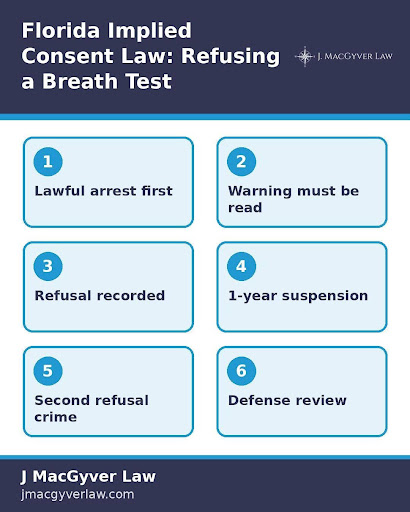
Those suspensions start on the day of arrest, and the ten-day deadline to request a formal review hearing applies to refusals just like it does to breath readings over the limit. The hearing officer looks at whether the deputy had probable cause and whether the warning was read before the refusal was recorded.
The refusal can also be mentioned at trial as evidence that you believed you were impaired. Prosecutors use it that way often, and juries in Sarasota and Manatee County hear it unless the defense gets it excluded before trial.
Walking Through a Refusal Case From Start to Finish
The way a refusal plays out depends on details that rarely show up in the arrest report summary. Here’s how we’d work through a common version.
Say a driver is stopped for an expired tag. The deputy notices the smell of alcohol and asks for field sobriety exercises, which the driver declines. After an arrest, the driver is asked to submit to a breath test and says they want to call a lawyer first. The deputy records this as a refusal.
The First Question Is Whether the Arrest Was Lawful
An expired tag justifies the stop. Smell alone is thin probable cause for a DUI arrest, so we’d look for anything else the deputy wrote down, such as slurred speech or unsteady walking, and compare it with the body camera footage.
The Second Question Is the Warning
Florida courts have held that you don’t have a right to a lawyer before deciding on a breath test. But the deputy still has to read the implied consent warning clearly. If the video shows the deputy rushing through it, or the driver never hearing it, the refusal may be challenged.
The Third Question Is What the Refusal Actually Looked Like
Asking for a lawyer can count as refusal if the officer explains there’s no such right and you still won’t test. If the deputy never explained that, the record is weaker.
Then Comes the Decision
The driver has ten days to request a formal review hearing on the one-year suspension. After a refusal, the driver can’t waive the hearing to get a business license right away. So we’d likely request the hearing, subpoena the deputy, and use the testimony to test both the arrest and the warning. Whatever we learn there shapes the criminal defense too. Without a breath number, the state’s DUI case leans on the deputy’s observations, which can be easier to question than a machine reading.
That’s how most refusal cases unfold. Florida implied consent law sets strict steps, and the defense looks for any step that was skipped.
Is Refusing Ever a Better Choice?
We can’t tell anyone in advance whether to refuse, and we never advise refusing a lawful request. The penalties for refusal are real, and a second refusal is a crime. What we can say is that a refusal case and a breath-test case are defended differently. With a reading, we look at the machine’s maintenance, the 20-minute observation period and whether two samples fell within 0.020 of each other. Without one, the focus shifts to driving behavior, video and the officer’s training. Our post on how a DUI charge can be dismissed in Sarasota shows where both kinds of cases can be challenged.
You can learn more on our DUI defense page, read about our Sarasota DUI lawyer services and our North Port DUI lawyer page, see what a criminal defense lawyer does before trial, or meet Attorney Jesse MacGyver Morse, a former Pinellas County prosecutor.
Talk to J. MacGyver Law
If you refused a test after a DUI arrest in Sarasota, Manatee or Charlotte County, call (941) 276-3154. We’ll review the arrest, the warning and your ten-day deadline under Florida implied consent law.

In a Hurry? Call (941) 276-3154
Frequently Asked Questions
Q: Do I have a right to a lawyer before a breath test in Florida?
A: No. Florida courts have said there’s no right to consult a lawyer before deciding whether to take the test.
Q: Is refusing a breath test a crime in Florida?
A: A first refusal isn’t a separate crime, though it brings a one-year suspension. A second refusal is a first-degree misdemeanor.
Q: Can the jury hear that I refused?
A: Generally yes, if the refusal was lawfully obtained after a proper warning.
Q: Are field sobriety exercises part of implied consent?
A: No. Florida implied consent law covers breath, urine and blood tests, not roadside exercises.
This article is general information about Florida law and is not legal advice. Reading it does not create an attorney-client relationship. Every case is different, and past results do not guarantee a similar outcome. The hiring of a lawyer is an important decision that should not be based solely on advertisements.